Spend a few minutes on social media and you might think the only way to build muscle or get stronger is to keep lifting heavier weights. While increasing weight is certainly one form of progressive overload, it’s far from the only one.
Progressive overload simply means gradually increasing the challenge placed on your muscles so they continue to adapt, grow stronger, and become more resilient. The challenge can come from heavier weights, but it can also come from more repetitions, improved control, longer holds, increased resistance, better technique, or more total work over time.
Your muscles don’t respond simply to the number printed on a dumbbell. They respond to the tension, effort, and training stimulus they’re exposed to.
What Is Progressive Overload?
Your body is designed to adapt. When you perform the same workout with the same intensity week after week, your muscles eventually become efficient at that task and stop receiving a strong reason to change.
Progressive overload gives your body a reason to keep improving.
Many assume this means constantly adding weight, but there are several effective ways to create overload:
1. Increase the Weight
This is the most familiar method. If you move from 15-pound dumbbells to 20-pound dumbbells while maintaining good form, you’ve increased the challenge.
2. Increase Repetitions
Performing 15 reps instead of 10 with the same weight increases the total work your muscles perform and can be an effective way to stimulate adaptation.
3. Add More Sets
Moving from three sets to four sets increases training volume and creates a greater stimulus for your muscles.
4. Slow Down the Movement
Controlling the lowering phase of a squat, lunge, or push-up increases time under tension and can make an exercise significantly more challenging without adding weight.
5. Add Pauses and Holds
Holding the bottom of a squat, pausing during a glute bridge, or extending a plank increases muscular demand and creates a new challenge for the body.
6. Improve Range of Motion and Technique
A deeper squat, stronger mind-muscle connection, or improved form can increase muscle activation and make an exercise more effective without changing the weight.
Light Weights Can Also Be Effective
One of the biggest misconceptions in fitness is that muscle can only be built with heavy weights.
In reality, muscles can respond to both heavier and lighter loads when the effort level is high enough. This is why high-repetition training can be so effective for building muscle and muscular endurance, while also improving strength—especially in beginners and intermediate exercisers.
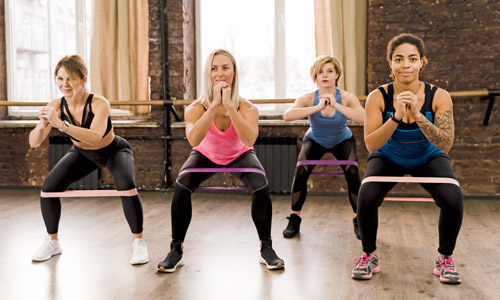
Think about the burn you feel during a barre class, sculpt-band workout, or a challenging bodyweight sequence. The weights may be light—or there may be no weights at all—but the muscles are being challenged through repetition, continuous tension, and fatigue.
Barre classes create overload through:
- High repetitions
- Small, controlled movements
- Isometric holds
- Extended time under tension
Resistance-band and sculpt classes create overload by:
- Increasing band tension
- Adding repetitions
- Improving control
- Increasing time under tension
These methods challenge the muscles and encourage adaptation just as traditional strength training does.
What About Pilates Reformer?
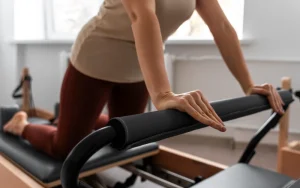
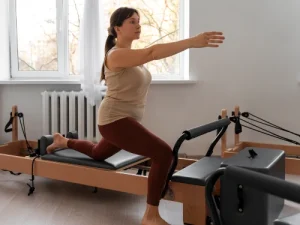
Pilates reformer training is another excellent example of progressive overload in action.
As strength and skill improve, overload can be created by:
- Increasing spring resistance
- Performing more repetitions
- Slowing the tempo
- Holding positions longer
- Progressing to more advanced exercises
While Pilates Reformer may not look like traditional weight training, it can help build strength, muscular endurance, stability, balance, and control while continually challenging the body in new ways.
The Most Effective Method Is the One You Can Sustain
One of the biggest mistakes we make is believing there’s only one “right” way to get stronger.
The most effective form of progressive overload is the one that allows you to train consistently, recover well, and continue progressing over time.
For some women, that may mean lifting heavier weights. For others, it may mean increasing repetitions, advancing to a stronger resistance band, progressing in a barre class, or mastering more challenging reformer exercises.
The method may look different, but the principle remains the same: challenge the muscles, allow them to adapt, and then gradually increase that challenge over time.
The Bottom Line
Progressive overload is not about chasing heavier weights every workout. It’s about continually giving your body a reason to adapt.
That challenge may come from:
- More weight
- More repetitions
- More sets
- Better form
- Longer holds
- Slower movement
- Greater range of motion
- Resistance bands
- Barre classes
- Pilates reformer training
Heavy strength training remains one of the best tools for developing maximal strength, but it is not the only path to progress. Progress happens when you continue to challenge yourself.